Tuesday, September 7, 2010

Pufnstuf at North Star Mall


North Star Mall is turning 50 years old this month. There is a celebration going on with a time capsule being opened. I put together some memories and photos for an Express-News submission.

For some reason, what always sticks in my mind is the red tile on the floor It was brick or saltillo, I can't remember. And the popcorn smell in the Walgreens. The high ceiling in the main "drag" by Luby's (still there)

And field trips to see movies at the General Cinema Theater: "Scrooge" with Albert Finney and "Oliver." I saw the feature "Pufnstuf" based on the cult Saturday Morning series. Many years later, I remember going to see "The Jerk" or "Black Hole" (not sure which) and being turned away due to the theater filling up and having to endure "Scavenger Hunt" in twin theater.

I remember one time going to see Anissa Walker ("Buffy") from "Family Affair." The crowds were so unruly and large for this doomed young starlet, that she had to be carried around on someone's shoulders.

The following pictures, taken by family friend Jimmy Kafka, detail an event I attended which featured HR Pufnstuf and many Krofft characters along with the iconic SA fixture Captain Gus. This must have been at least 1971 or so as "Lidsville" wasn't released until that fall.

The Rockstar arrives sans Witchiepoo - HR Pufnstuf:

The Krofft brothers denied it, but here is Pufnstuf tripping:

I just asked Pufnstuf if I was on acid at the time:

A couple of characters from another Krofft show: "Lidsville":

Trying to swing with a star:

The North Star Mall "Mascot" was hot.

No event would be complete without Captain Gus. He hosted the local Channel Five kids show which featured Popeye cartoons and Little Rascal shorts, "Ahoy Mateys".

Captain Gus. All these kids had been on his show at one time or another.

The politically incorrect "Frito Bandito" was replaced by this character-WC Fritos, a child-hating drunk.

I couldn't wait to get some Pufnstuf:

Puf was checking out the North Star - didn't even notice me there. Damned stoned dragons.

Future Tea Party members await their LSD-inspired puppet icons:


Coming of age- Not only did I have to deal with the North Star-let, but Pebbles was growing up as well.

Thursday, August 19, 2010

A Colossal Mess of Roman Proportions

Forty years later, I finally have the answer. The fact that this is a topic that has remained on the fringes of my consciousness for so long speaks volumes about my neurosis. But thanks to the World Wide Web (as it's called), someone finally addressed this issue.

In 1969, I purchased this one-shot Gold Key comic:


I noticed in the publisher information that it was created by "Total Television" which were the cartoon producers behind "Underdog", "Tennessee Tuxedo", and "Go Go Gophers". They were animated by Gamma Studios, a cartoon factory in Mexico that was contracted to make cartoons for General Mills cereal ads. And this place also animated the Jay Ward cartoons: "Bullwinkle and Rocky" and "George of the Jungle". Many people are confused by this, thinking that these were all made by the same creative teams. They just looked alike.

Anyway, I never saw an animated version of this. Or even heard or read of one.

So two years later, on Saturday morning on NBC, we have "The Roman Holidays", a Hanna-Barbera sitcom with similar characters (and even a lion). I bought the first issue of that comic book.


But thanks to Scott Shaw's blog, based on information from Mark Arnold's book, we have an answer. I am grateful, that I am not the only uber-geek over forty who obsessed over this.


So buy Mark's book. Support my fellow cartoon geeks.

Tuesday, August 10, 2010

Powder Puff Comedies

Ladies and Gentlemen, I give you Chevy Chase in his finest comic performance:


The "drug of choice" in the early 80's, at least for comic fodder, was the white stuff. It was almost an obsession with filmmakers leading up to the penultimate "Scarface". But in today's politically correct world, wacky comedies can only rely on masturbation and murder. Does that mean today's comedy writer's get inspired by....well, self-gratification and homicide? Oh-well. Here are three examples I remember vividly from that era.

"National Lampoon's Heavy Metal" with a voice cast from SCTV including Eugene Levy, Harold Ramis and John Candy:


"Jekyll and Hyde...Together Again" starring Mark Blankfield, written and directed by Jerry Belsen, who wrote for Dick Van Dyke and Odd Couple:


"Modern Problems" with Chevy Chase and Nell Carter:


And here I thought The Great White Way referred to Broadway.

Tuesday, August 3, 2010

MUNSTERS AND ADDAMS AND SPAWNS..OH MY!


Most of you know about the conspiracy/controversey regarding the Addams Family/Munsters scheduling. Both premiered in fall of 1964 and ran two seasons on different networks (ABC and CBS respectively). The Addams, however, had a long history. The macabre family was started as a single panel comic strip in the New Yorker by Charles Addams many years before. The Munsters, a throwback to the Hammer Monster films, was a relatively new creation.


After six years of being rerun, Hanna-Barbera animated the Addams Family (based on their original comic look) for an episode of Scooby Doo Movies in 1972 which led to their own cartoon series the following year on NBC. And there was a barely remembered reunion special with most of the original cast on NBC in 1976. After that, more animated versions appeared and two financially successful feature films were produced. As for The Munsters, the original run was followed by a feature film, "Munsters Go Home". The only animated version was called "The Mini-Munsters" produced by Fred Calvert for a one time special run on the ABC Saturday Superstar Movie in 1972.


But there has been massive confusion regarding the proliferation of monster "families" during the sixties in cartoonland. For instance, Hanna-Barbera had "The Gruesomes" (almost a cross between the Addams and Munsters) featured in a Snooper and Blabber cartoon.
They would later be prehistorisized and become regulars in episodes of "The Flintstones".


Also, Hanna-Barbera created "Mr. and Mrs. J. Evil Scientist". This more sophisticated gruesome family appeared in a "Snagglepuss" episode. Although they never had their own cartoon series, they were featured in their own four issue Gold Key Comic in the sixties.

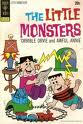
Strangely, around this same time (1964...also then the Munsters and Addams started TV sitcoms) Gold Key created their own monster family "The Little Monsters" which ran succesfully through the seventies. This was never animated.

Similar looks and styles abounded on Saturday morning: Hal Seeger's "Milton the Monster", "Frankenstien Jr."(Hanna-Barbera), the Gruesome Twosome on "Wacky Races" (also Hanna-Barbera), and, of course, Sabrina's friends "The Groovy Goolies" (Filmation).


And also, in 1967, Rankin-Bass created a feature film using their puppet-style animation (see "Rudolph the Red Nosed Reindeer" for "The Mad Monster Party". They animated a sequel to this, also for the Saturday Superstar Movie' the same year as "The Mini-Munsters".

Confused yet?

Friday, March 26, 2010

January 12, 1971


January 12, 1971. The following words appeared on a television screen:
"The program you are about to see is All in the Family. It seeks to throw a humorous spotlight on our frailties, prejudices, and concerns. By making them a source of laughter, we hope to show -- in a mature fashion -- just how absurd they are”.

“All in the Family” premiered. At the time, it was shocking, controversial, considered subversive by some….brilliant by others. If you don’t know what this series is, look it up.

I remember watching it weekly a couple of years later. Mostly, I caught the daily reruns CBS “stripped” after the game shows during the summer.

In a nutshell, Archie was a bigoted, profane conservative. Mike, his son-in-law was a long-haired, liberal academic. Their arguments were well-written, timely, and very very funny. I have written ad nauseum about how our current “culture wars” simply regurgitate Archie and Mike. I’m not going to wax politic about that particular dynamic here. I want to talk about comedy and satire.

Norman Lear’s series, which included “Maude”, “One Day at a Time”, “Good Times”, “The Jeffersons”, “Sanford and Son”, and
“Mary Hartman, Mary Hartman” were different than previous sitcoms. They were videotaped and looked very much like stage plays. The live audience was very present. You not only heard laughter but gasps and groans. They were not always funny, sometimes they were mini-dramas (and not very good ones at that).

But the comedy, the satire. Lear has been labeled a liberal. He is. He founded People for the American Way, a First Amendment-protecting organization. He owns the Constitution, literally. He also served in World War II, flying 52 combat missions and being awarded the Air Medal with four Oak Leaf Clusters. He comes from a generation where liberal/conservative labels didn’t define someone to the point of derision or ridicule. He paid his debt to his country. His point of view was reflected in his works.

Archie Bunker (although based on a British character) was inspired by Lear’s own father. Maude Findlay, Archie’s sister-in-law, a liberal whose politics outmatched Archie’s in terms of self-immolation, was inspired by Lear’s wife. The art is personal.

Lear’s early sitcom work was extremely well-written, funny, and character-driven. It was topical and dealt with the issues of the day. Later, it became rather stagy and pedantic. But look:

1971: “All in the Family”: Racist Anglo blue-collar man shares house with Liberal “hippie” son-in-law and progressive daughter. They both fall on their face sometimes, mostly Archie though.
1972: “Sanford and Son”: Racist African American runs a junk yard with his son in Watts, as in riots Watts. He falls on his face sometimes with his son saving his ass.
1972: “Maude”: Politically correct liberal woman deals with being a feminist in a world not ready for her. And sometimes falls on her face with her family saving her ass.
1974: “Good Times”: An African-American family deals with the trials and tribulations of living in the projects. Striving and struggling for the American dream. Nobody falls on their face here because hypocrisy isn’t an issue.
1975: “The Jeffersons”: An African -American family has made it and moves to a high-rise in Manhattan. The patriarch, an elitist racist, often falls on his face, saved by his wife.
1976: “One Day at a Time”” A newly-divorced young woman with two daughters tries to make it on her own in a world of changing sexual politics. The only one falling on his face is the nosy, lecherous super.
1976: “Mary Hartman, Mary Hartman”: A middle-American housewife has the longest nervous breakdown in TV history.

So, you see this isn’t “Beverly Hillbillies”, “Andy of Mayberry”, “Bewitched” or “Leave it to Beaver”. While the concurrent stable of Mary Tyler Moore-produced sitcoms were intelligent and slick, they rarely ventured into controversy. Garry Marshall’s sitcoms wallowed in nostalgia. Others of the era were awash in titillation, innuendo, and insults. “Barney Miller” stood on it’s own as an understated comic masterpiece. “MASH” was irreverent and subversive, eventually leading to preachy literate boredom (and, the highest rated finale of all time, go figure).

You could not put these shows on now. Oh, sure, we live in the most permissive TV environment blah blah blah. No, we don’t.

Lear, an avowed liberal, created shows that were SATIRE. “All in the Family” was the perfect example. He made fun of ALL types of characters. Like real-life, everyone had flaws. No one was a saint. No one was pure evil. It was a reflection of society. It mirrored the dichotomous nature of humanity. He didn’t just trash conservatives. He trashed liberals. He trashed minorities. He trashed them all lovingly. What does this mean? It means he loves people, regardless of who they are. That’s why he’s a great American. I remember seeing an interview with a WW 2 veteran who said that the famous “Vietnam” episode of AITF aided and abetted the enemy during the final years of that war. No. He humanized the conflict that Americans were experiencing during one of the most horrific times in our history.

And you see, the thing is….this is where nothing has changed. When anyone tries to examine the human condition….from a political satire standpoint…it is considered seditious. Why? Unless an observor follows a “formula” of red or blue, they are fringe.

So where are we now? What is shocking and subversive (in the good sense of course). Oh, “South Park”, torture porn, something on HBO or Showtime because it allows profanity and nudity. Bullshit. This is shock. How far can we go? No redeeming message comes out of this. No enlightenment. But, you say, it’s “entertainment”. Fine, and I feel sorry for you. But don’t fool yourselves into thinking it is daring, thought-provoking, or groundbreaking. It’s just childish and prurient. “All in the Family” could not get greenlit today. It has no nudity, graphic sex, f-bombs, torture, gore, rape, bodily fluids, racial insults, humiliation, pornography, or disembowelments. Wake up, America. These “daring” elements are corporate-borne profit-makers. It takes no intelligence or thoughtfulness to write this tripe.

Norman Lear was a pioneer. And he blazed a trail that would soon be covered up and forgotten for the sake of profit and sensationalism.

Yeah, he was a consultant on South Park for a while. I guess he understood that those guys were satirists in their own way. At least they make fun of EVERYONE, even if it’s done in a juvenile way. And Sarah Silverman, as funny as she is claims it’s ok to make fun of EVERYONE EXCEPT WOMEN. Well, that’s fine…but if you make fun of disabled and mentally retarded people, all religions, all ethnicities…..and give exception to any one group, you are not a satirist but a self-indulgent comic.

And, yeah, as Lear’s shows grew older they became more silly (see “The Jeffersons”) ar more soapy (see “One Day at a Time”) or ruined by showcasing one badly-drawn character (see “Good Times”) or more star-driven (see “Archie Bunker’s Place”).

But he did something no one has done since. He examined the American condition without prejudice, without cruelty, with humor, with pathos, with talented acting and writing, with thoughtfulness, with fairness, with bravery. Sounds like the American ideal to me. Thank God he owns the Constitution.

Monday, December 28, 2009

TOP DOCUMENTARIES OF THE DECADE

As with my previous top ten list, my top documentary list is sure to omit many excellent films which I just did not see. There are many of these films that I had been told I must see, but I just didn’t. That being said, these are my stand-outs in no particular order.

Confessions of a Superhero (Matthew Ogens).
The poster for this film depicts Christopher Dennis, an actor posing as Superman on a therapist’s sofa. This is the perfect image for Confessions. Four struggling actors put on superhero costumes and hang out on Hollywood Boulevard posing for pictures with tourists for cash in between auditions. All four of these individuals are so well fleshed out that you share their broken (and in one case, realized) dreams. Hopeful and heartbreaking at the same time, Confessions shows that in the journey to realize our dreams, through self-delusion or hard work or both, we discover our blessings and true talents.

All We are Saying (Rosanna Arquette). Actress Arquette (8 Million Ways to Die) interviews many famous musicians about the creative process and the changing face of the music industry. What could be a lot of pretentious talking heads turns out to be a life-affirming examination of the passion involved in creating anything that is a piece of yourself.

Maxed Out (James Scurlock). Scurlock does an excellent job of translating his book of the same title to the big screen. An incisive and sobering look at the credit card / lending industry and its predatory practices on those with the most to lose. Maxed Out is a great companion piece to Enron: the Smartest Guys in the Room and The Corporation, two other great docs this decade about the corporate malfeasances that have led to the mess we are in today.

Slasher (John Landis). Famed comedy and horror director Landis examines predatory behavior as well. This time it involves the used car business. The film follows Michael Bennett, a traveling ringmaster of festive “slasher” sales. Bennett, a genius at the art of valuing automobiles and closing the deal, provides a gateway into the manipulations inherent in these activities directed to those in the lower socio-economic circles. It shows how much and how little things have changed since The Maysle’s Salesman from 1968.

Hard Road Home (Macky Alston and Andrea Meller). No doc had the visceral impact on me than this one. HRH profiles the Exodus Transitional Community, a faith-based group of ex-convicts in Harlem who have banded together to provide job-placement for their peers. The struggles that lead to failures and victories are documented so effectively that you know these flawed heroes so well by film’s end. During the screening I attended, Julio Medina, the founder, was introduced and I felt overwhelmed by a heroism that one can rarely find in today’s world. Go to http://www.etcny.org/ to learn more about this exceptional program.

Journeys with George (Alexandra Pelosi). There was such a plethora of political documentaries these past ten years that they sort of blended together. This one stood out by trumping wonkishness with personality. Before the new culture wars and before 9/11, Pelosi, a liberal photojournalist, palled around with George W. Bush on his campaign media tour in 1999. Although on opposite ends of the political spectrum they develop an awkward fondness for each other that cannot exist today in the red meat partisan wars drummed up to sell division and diversion. The relationship between the daughter of the right’s soon-to-be public enemy number one in the House and 43 himself, shown in a light that perhaps is his truest goofy persona (one that should have remained on the bus by the way) mirrors an uneasy harmony between the left and right which was reflected in the screening I attended in the capital of Texas with bigwigs from both parties cheering and heckling at different scenes. Those were the days.

Zombie Girl: The Movie (Justin Johnson, Aaron Marshall, and Erik Mauck). Zombie Girl documents twelve-year old Emily Hagen making her first film, Pathogen. To anyone who has ever set out on a dream project whether it be film, theater, music or anything else, this story can hit home like no other. Part filmmaking tutorial, part family relationship drama, part coming of age comedy, ZG is entertaining, informative and heartwarming. Winners of the Spirit of Slamdance Awards, the filmmakers have succeeded in the art of showing and not telling (or editorializing on) a story about real people creating an unreal world and all the difficulties that lie therein. With a wonderfully appropriate soundtrack that will stay with you as much as Emily and her family does. Side note: An interesting counterweight to this film is the doc Lost in La Mancha which painfully documents the travails of Terry Gilliam failing to realize his big-budget adaptation of Don Quixote.


Fog of War (Erroll Morris), Trials of Henry Kissinger (Eugene Jarecki), and Why We Fight (also Jarecki). These three documentaries are a not-so-unbiased but effective study of the lingering effects of decisions made that affected millions of lives. These films together provide an excellent mosaic of the history of our country, our military, and our leaders during a period of pre-assassination paranoia and later years of our nation’s cancer of hopelessness and despair. Whereas Michael Moore incites and divides, these films make their points with a studied dignity.

Life of Reilly (Frank Anderson and Barry Poltermann). A document of the stage play performed by Charles Nelson Reilly, not long before he passed away. Reilly, who most people would know as the sarcastic Greek chorus from Match Game and (to us Saturday morning geeks) Hoodoo from “Lidsville”, discusses his life in this funny, touching, and revealing dialogue interspersed with clips and photos. You have to see the film (or start googling) to discover what a rich, influential, and troubled life Reilly led. There is so much more to a famous life than what is just remembered and regurgitated.

Fish Kill Flea (Brian Cassidy, Aaron Hillis, Jennifer Loeber) and The Last Western (Chris Deaux). I disingenuously lump these two well-made docs together as they both reflect a lost era in today’s ever-changing world through a place suspended in time. The former a seventies-era supermall in upstate New York turned rag-tag flea market. The latter a Golden Era Western movie set turned into Pioneertown. Interviews and footage of the colorful inhabitants of these respective dinosaurs are sad, funny, and very American. In a changing American landscape.

Honorable Mentions:
Hell on Wheels (Bob Ray) Documenting the re-birth of the female Roller Derby in Austin Texas and the conflicts between the two upstart leagues. Painful and thrilling. Much like roller derby, I imagine.

Hell House (George Ratliffe) A Christian haunted house in North Texas suburbia. What could have been a cynical attempt to mock religion is frightening look at the lengths evangelism can take.

Finally:
A Special screening of A President to Remember with filmmaker Robert Drew doing a q and a afterwards. The father of cinema verite in America (director of the revolutionary “Primary” in 1960 of which footage was used), Drew pieced together candid and incredibly revealing footage of the Kennedy White House. To see behind the scenes “home movies” of Camelot and then hear from the man behind the camera was too much excitement for this political junkie. A night to remember. An honor.

Sunday, December 20, 2009

TOP STUDIO FILMS OF THE DECADE PLUS THE SCOTTY AWARDS

My “Top Films of the Decade” list is very subjective for two reasons. First, I haven’t seen enough films over these past ten years to give a comprehensive and diverse overview. Second, the best films I’ve seen are revisited or new viewings of amazing films of the 60’s and 70’s. To compare apples to apples, I have three categories: Top American Studio films; Top Independent/Festival films; and Top Documentary Films. Here is my Studio list:

Note: Many of my Studio films were released as “independents” but if they include major star power, second generation power directors, or are produced through a mini-major boutique studio, they are considered studio films here.

Top Ten Hollywood Films (followed by the obligatory obsessive compulsive second top ten and my Scotty awards):

Sideways (Alexander Payne) Payne proves again that he is the closest director we have to the humanistic, literate character-driven comedies of the 70’s (see Hal Ashby). Paul Giamatti and Thomas Haden Church create the Odd Couple of the new millennium in this film that speaks to everyone who has a dream, gave up on a dream, is in love with life and in love with misery. In other words, being an artist and being human.
Kiss Kiss Bang Bang (Shane Black) Black’s directorial debut was the closest I felt to the sheer cinematic excitement I felt upon my first viewing of Raiders of the Lost Ark over thirty years ago. (And I told him so in the Driskill lobby.) Simply
thrills, great acting, hilarious and chilling surprises, insane premise, and surprises galore. Downey was born to play this role and Kilmer starts his grand stroll into excellent character acting.
Dogville (Lars Von Trier) Once again, pushing the envelopes of taste and propriety, Von Triers has created a world (literally) on a stage that shocks, reviles, amazes, and is the truest reflection of society, scarily. A much-needed whack in the head released in the buildup of the new culture wars.
Ghost World (Terry Zwigoff) This film spoke to me on so many levels….the nerd, the outcast, the comic book collector. In a strange world between modern grime and retro chic, this Ghost World is a funny and tender meditation on our obsession with the past and our uncertainty about our future (among many other things) in a politically correct world.
Eternal Sunshine of the Spotless Mind (Michel Gondry). Jim Carrey in his best role and Kate Winslet at her most organic (save, maybe Holy Smoke) in this psychedelic tone poem with a socko soundtrack. What could be pretentious turns into a universal story about unrequited love. One of the best casts of the decade and a killer script by Spike Jonze.
Little Children (Todd Fields). Don’t be fooled by the subject matter. Based on the book by Tom Perotta, this adaptation adds to the themes, rather than diminishes them. A biting satire in the guise of a haunting melodrama, this is one of those films that takes you into a world for two hours and it feels like one. From the inspired spoken narration to the mesmerizing Oscar-nominated comeback performance by Jackie Earle Haley, Little Children pulls no punches in examining groupthink and mores in modern America suburbia.
Return to Me (Bonnie Hunt) Yes, my cynical ass has hated formula romantic comedies for some time…except this one. Written by, directed by, co-starring the Chicago wunderkind Hunt (my wife in another life, I’m sure), Return to Me is funny, sad, smart, heartwarming, sardonic and, even with a contrived premise, believable. And a Dean Martin soundtrack to boot. Rom-coms shouldn’t die off, they just need to be all made by Miss Hunt.
Lost in Translation (Sophia Coppolla). This is the part Bill Murray was destined to play and it resurrected his career into an Indiewood Icon. From the inspired setting in Tokyo and the show-biz in-jokes scattered throughout to the sexily sullen Scarlett Johansson and the appropriately ambiguous ending, Coppolla captures the angsts and longings of young and old. Beautifully shot and scored.
Monster’s Ball (Marc Foster) Much has been said about the lovemaking between Halle Berry and Billy Bob Thornton in this terrifying slice of southern gothic, but the real thrill lies in the brutally honest yet hopeful portrayal of race and class relations since Ashby’s “The Landlord”.
Watchmen (Zach Snyder) Save “Ironman” I haven’t jumped on the superhero bandwagon. But this film, based on Alan Moore’s graphic novel, is much, much more than an action film. It is Forrest Gump on an acid trip with Dr. Strangelove. The revisionist history and political satire are thankfully ramped up from the source, creating an over-long but satisfying study on what makes a hero in a world of anti-heroes.

Runners-Up (Next 10)

Bobby (Emilio Estevez). Through the music, settings, and costumes, this ensemble film about the few hours leading up to RFK’s assassination accurately reflects the shattered dreams of a confused America in 1968 witnessing Her third earth-shattering tragedy in five years time.
School of Rock (Richard Linklater) Much as Bonnie Hunt did with a formula revamp in “Return to Me”, Linklater proved that comedies about underdog kids overcoming adversity doesn’t have to pander to audiences through cheap sentimentality, crude gags, and cartoonish characterizations. This film is the closest he came to the original Bad News Bears.
Punch Drunk Love( Paul Thomas Anderson) Anderson figured out how to use Adam Sandler’s talents in this off-beat and delightfully uneven love story. Instead of playing his stuttering man-child with a temper for laughs, PT and Sandler created a complicated, tortured protagonist with some real anger issues…who falls in love. Everything from the act-changing visuals to the “Popeye” soundtrack add to one of the most bizarre love stories since Harold and Maude.
The Cooler (Wayne Kramer). Much as the Ocean’s Eleven remake tried to do, The Cooler,
with strikingly honest performances by William H. Macy and Maria Bello, portrays a Las Vegas that is dying and leaving behind its Rat Pack roots to wallow in corporate servitude.
Maria Full of Grace (Joshua Marsten) With a beautifully realized star-turn by Catalina Sandino Moreno) this film is a chilling and hard-hitting exploration of the sordid lengths one must go through to escape a horrendous situation only to be in a new world of continued but slightly more hopeful depravity.
Reservation Road (Sam Mendes) Although slightly marred by Leo’s histrionics, Mendes’s best film since American Beauty is a journey into the past that peels the skin off of the Man in the Gray Flannel Suit and exposes the blood and guts of unrealized potential, dreams unanswered, torrid attachments, unsatisfied yearnings, and finally, the ultimate betrayal.
Before the Devil Knows You’re Dead ( Sidney Lumet) Lumet (“Network”, “Dog Day Afternoon”) still has it, resurrecting the edgy realistic tension of the best seventies crime thrillers (like Spike Lee’s “Inside Man”also did this decade).
Pursuit of Happyness (Garbriele Muccino). Surprisingly uncheesy, unpreachy story of hope with Will Smith in one of his best performances.
Michael Clayton (Tony Gilroy). Another welcome throwback to seventies conspiracy porn, this feature (with the last on-screen performance of the great Sidney Pollack) is well-paced and smartly written with Tilda Swinton providing one of the best characterizations of the decade.
Art School Confidential (Terry Zwigoff) A second cousin to Ghost World, “Confidential” takes the hilarious mocking of the pretensions of the art world in the former and expands upon it.

Wild Card:
"Once" (John Carney) Not sure how to classify this one....foreign film, indie, musical, drama...whatever. Anyway, this Irish film was a beautiful narrative rendition of the relationship between two people. Effectively using songs (hard to do) to convey emotions and conflict. Sadly, I saw the leads, Glen Hansard and Marketa Iglova, perform at Stubb's and watching the worshipping fan-base swoon over the Swell Season, took away the melancholic underdog vibe of the film.

SCOTTY AWARDS for the decade:

Scene Stealer: Fred Willard in “Best in Show”
Funniest Woody Allen film: “Hollywood Ending”
Best Meet-Cute: Mickey Rourke and Marisa Tomei in “The Wrestler”
Better Than Ever Female: Marisa Tomei
Overall Female Performances: Kate Winslet
Most Consistently Good Female Performances: Laura Linney
William H. Macy Pinch Hitter Award: JK Simmons
Overall Male Performances: Phillip Seymour Hoffman
Better Than Ever Male: Josh Brolin
Consistently Good Male Performances: Tom Wilkinson
Biggest Disappointment: Men Who Stare at Goats
Best Justification to see sex and violence: History of Violence
Best First Five Minutes in the Biggest Unrealized Potential of a Film: “Idiocracy” (Mike Judge)
Biggest Loss: Robert Altman
Biggest Fraud on the Moviegoing Public: “The Terminal” (Steven Spielberg)
Most Eagerly Awaited and Most Easily Forgotten:
“Indiana Jones and the Kingdom of the Crystal Skulls” (also Spielberg)
Worst Trend: Torture Porn
Most enjoyable studio film I only saw ‘cuz it was shot locally: “Miss Congeniality” (Donald Petrie).
Guilty Pleasure: “Down with Love” (Peyton Reed)
Biggest emotional punch in the Stomach: “In America”(Jim Sheridan)
Best Western: “The Proposition” (John Hillcoat)
Best Western: Hotel
Worst Trend in Independent Films: Independent Films following an Independent Film Formula and sadly, succeeding (see “Napolean Dynamite”)
Most welcome and needed return of a genre: satire
(see “Thank You For Smoking”, “Bamboozled”, “War, Inc.” , “Pretty Persuasion”, “The TV Set”, and “Tropic Thunder”)
Straight to DVD special mentions: “Come Early Morning”, "The King", “Oh in Ohio”, “Pretty Persuasion”, “Diggers”.
Best neurotic return to indie filmmaking of yore: "Frownland"(Ronald Bronstein)
Favorite festival find not released on DVD: "Sexless" (Alex Holdridge)...Woody Allen meets Richard Linklater, a template for my dream project.
Favorite festival find released on DVD: "Easy Listening" (Pamela Corkey). This Boston-shot indie is a "Marty"-like story of love set in the 60's. Set in the world of elevator music, the film evokes the nostalgic feel of those Capitol Record album covers and the cool, almost hip but not quite feel of the era.


Stay Tuned for my indie and doc lists.